

John Mark

Updated: Sep 1

Introduction
John Mark (Hebrew: Yochanan Markus / Greek: Iōannēs Markos) was born around AD 15 in the Roman province of Judea. He was a Jewish man named Yochanan (H3076, "God has been gracious"). His other name, Markos (G3138), was derived from the Latin name Marcus. He lived in Jerusalem, and his mother, Mary, was a wealthy woman (Acts 12:12). Mark later became closely associated with Peter and traveled with Paul and Barnabas on missions across the Mediterranean (Acts 12:25; 13:5, 13). Additionally, Mark and Barnabas were cousins (Col. 4:10).
Mark played a central role in the disagreement between Paul and Barnabas when they parted ways after the Council of Jerusalem around AD 50 (Acts 15:36–40; Gal. 2:13). However, several of Paul's letters suggest that he later reconciled with Mark, even calling him "helpful to me in my ministry" (Col. 4:10; 2 Tim. 4:11; Philem. 24). This reconciliation highlights the importance of forgiveness and second chances within the early Christian community.
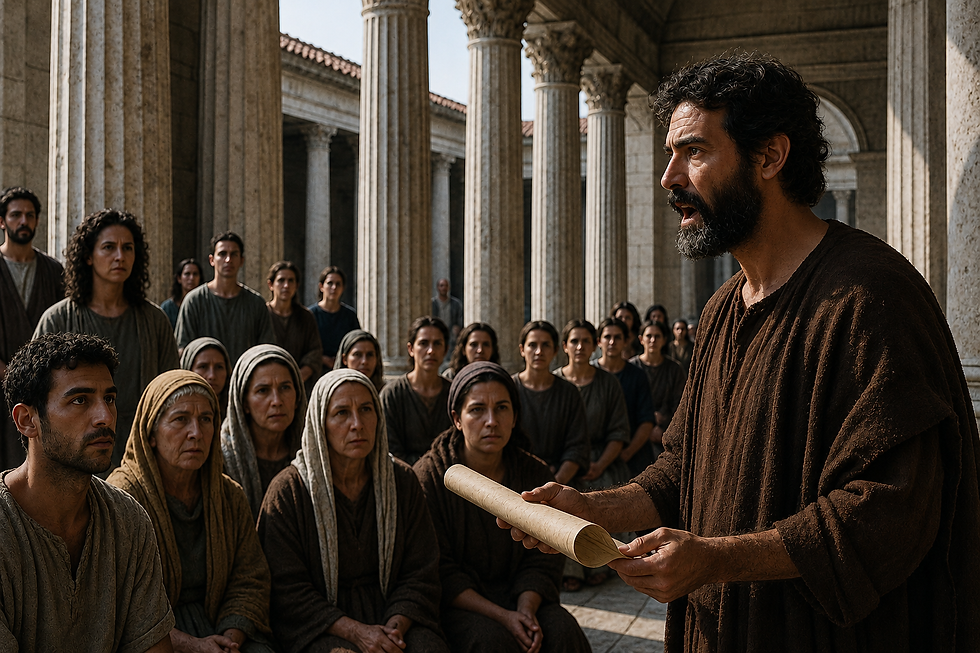
Mark the Evangelist
The New Testament does not explicitly identify the author of the second gospel. However, it contains one indirect reference that early Christian writers associated with its authorship: "She who is in Babylon, chosen together with you, sends you her greetings, and so does my son Mark" (1 Pet. 5:13). The earliest surviving testimony connecting Mark with Peter comes from Papias, preserved by Eusebius in his Church History, which declares:
Thus when the divine word had made its home among them, the power of Simon was quenched and immediately destroyed, together with the man himself. And so greatly did the splendor of piety illumine the minds of Peter’s hearers that they were not satisfied with hearing once only, and were not content with the unwritten teaching of the divine gospel, but with all sorts of entreaties they besought Mark, a follower of Peter, and the one whose gospel is extant, that he would leave them a written monument of the doctrine which had been orally communicated to them. Nor did they cease until they had prevailed with the man and thus become the occasion for the written Gospel of Mark.
They say that Peter, when he had learned, through a revelation of the Spirit, of that which had been done, was pleased with the zeal of the men, and that the work obtained the sanction of his authority for use in the churches. Clement, in the eighth book of his Hypotyposes, gives this account, and with him agrees the bishop of Hierapolis, named Papias. And Peter makes mention of Mark in his first epistle which they say that he wrote in Rome itself, as is indicated by him, when he calls the city, by a figure, Babylon, as he does in the following words: "The church that is at Babylon, elected together with you, salutes you; and so does Marcus my son" (Hist. eccl. 2.15; cf. 1 Pet. 5:13).
Eusebius also wrote this statement about Mark based on Papias' testimony:
This also the presbyter said: Mark, having become the interpreter of Peter, wrote down accurately, though not in order, whatsoever he remembered of the things said or done by Christ. For he neither heard the Lord nor followed him, but afterward, as I said, he followed Peter, who adapted his teaching to the needs of his hearers, but with no intention of giving a connected account of the Lord's discourses, so that Mark committed no error while he thus wrote some things as he remembered them. For he was careful of one thing, not to omit any of the things which he had heard, and not to state any of them falsely (Hist. eccl. 3.39.15).
Furthermore, the Anti-Marcionite Prologue to the Gospel of Mark states: "Mark was called 'Stumpy Finger' because his fingers were too small in proportion to the rest of his body. He served as Peter's interpreter. After Peter's death, the same man wrote this gospel in parts of Italy" (Anti-Marionite Prol. Mark).

Gospel of Mark
Eusebius wrote, "They say that this Mark was the first that was sent to Egypt, and that he proclaimed the Gospel which he had written, and first established churches in Alexandria" (Hist. eccl. 2.16). While later traditions expanded Mark's legacy, contemporary scholarship continues to recognize the significance of his gospel. Most scholars consider Mark to be the earliest of the four canonical gospels. Many also accept the Q hypothesis, which proposes that Matthew and Luke shared an additional collection of Jesus' sayings, known as Q (from the German word Quelle, meaning "Source"), in addition to Mark. Although the existence of Q remains debated, the Gospel of Mark likely served as a principal written source for Matthew and Luke. The Q hypothesis seeks to explain the "synoptic problem" (from Greek: sunoptikos, "seen together," G4862 / G3799), the reason Matthew, Mark, and Luke share the same material. Although Mark appears as a minor figure in the New Testament, he worked closely with Peter and Paul and had access to some of the earliest sources about Jesus.
Bibliography
Primary Sources
The "Anti-Marcionite" Prologues to the Gospels.↗ Translated by Roger Pearse from the text of Donatien De Bruyne. 2006.
Eusebius. Church History. Translated by Arthur Cushman McGiffert. In Nicene and Post-Nicene Fathers, series 2, vol. 1. Edited by Philip Schaff and Henry Wace. Grand Rapids: Eerdmans, 1890.
Commentaries
France, R. T. The Gospel of Mark. New International Greek Testament Commentary. Grand Rapids: Eerdmans, 2002.
Keener, Craig S. The IVP Bible Background Commentary: New Testament. 2nd ed. Downers Grove, IL: IVP Academic, 2014.
Monographs
Bauckham, Richard. Jesus and the Eyewitnesses. 2nd ed. Grand Rapids: Eerdmans, 2017.
Strauss, Mark L. Four Portraits, One Jesus: A Survey of Jesus and the Gospels. 2nd ed. Grand Rapids: Zondervan, 2020.
Journal Articles
De Bruyne, Donatien. "Les plus anciens prologues latins des Évangiles."↗ Revue Bénédictine 40 (1928): 193–214.
Online Resources
Nelson, Ryan. "Who Was John Mark? The Beginner's Guide."↗ OverviewBible. April 17, 2019.


